The index
Writing
Essays on building with AI agents: context engineering, agents on the team, and the craft of shipping. Every essay, newest first.
October 2026 5 essays
- 25

Compound engineering is our factory floor
A ten-person team's agents run on one plugin: humans own the plan and the review, agents the rest. In one October week we merged 469 PRs.
· 9 min
9 min read - 24

Orders get obedience. Questions get opinions.
I don't tell the model what to do. I ask it, because an order caps the answer at what I already knew, and a question leaves room to be wrong.
· 5 min
5 min read - 23

The State of AI 2026 bets your next customer is an agent with a wallet
The 244-slide State of AI Report 2026, cut to what a startup CTO can act on: who earns the money, what an answer costs, and nine bets for next year.
· 7 min
7 min read - 22

Drift by a thousand suggestions
I asked an AI to review the same clean file ten times and applied every change. By round three it had invented a feature. By round four it was citing that feature as my spec.
· 11 min
11 min read - 21

Fifteen years of GitHub stars, one AI wave
I went through 2,143 GitHub stars from 2011 to today. AI repos go quiet at the same rate as everything else. What changed is who reads the README.
· 6 min
6 min read
September 2026 4 essays
- 20

Agents should draw their work. Miro MCP lets them.
Agents now make more than anyone can read. Connect Claude Code or Codex to the Miro MCP and have them draw it instead. Five skills to copy.
· 9 min
9 min read - 19

BM25 got Orama. Jev still needs one.
I tried to build an Orama for Jev. It matched the best hand-tuned call on one catalog and lost by 19 points on real MCP tools. The defaults are the product.
· 7 min
7 min read - 18

Picking the right tool for an LLM is a decision. Jev makes it.
Claude's tool search ranks with BM25. On 525 real MCP tools, Jev put the right tool first 56% of the time to BM25's 32%, and it could say none of them fit.
· 11 min
11 min read - 17

Your AI hub can't do the 70%
BCG puts 70% of AI's value in ways of working. That is the one thing a central hub structurally cannot do for you, and nobody ever measured the number.
· 10 min
10 min read
July 2026 6 essays
- 16

The lights were never off
The man who coined "dark factory" runs at Level 4. The man who popularized it calls it unproven. The teams who built one never say the words.
· 15 min
15 min read - 15

Write the done-condition, not the prompt
How I write prompts, audited against 138 of my own. Four habits, one rule, and the single edit that fixes most of them.
· 6 min
6 min read - 14

Loop engineering is verifier engineering
Eleven articles, 43 million views, one idea: design loops that prompt your agents. They all agree you need a verifier. Almost none of them are one.
· 16 min
16 min read - 13

Prompt engineering is over. You're a context engineer now.
Prompt engineering quietly gave way to context engineering. The catch: most teams doing it are doing it backwards.
· 10 min
10 min read - 12

The AI coworker is a weekend project now
Viktor and Martoshi make the AI-employee-in-Slack look like a company. We built the same shape on Vercel's Eve in one session.
· 4 min
4 min read - 11

Your product is the easy part now
AI collapsed the cost of building software. The bottleneck moved from creation to adoption, and most founders are still optimizing the solved side.
· 3 min
3 min read
June 2026 9 essays
- 10

The chat UX is the product, not the model
shadcn calls it scroll engineering. It is bigger than that. Users don't churn on your model, they churn on the chat UX around it.
· 3 min
3 min read - 09

Stop picking npm or shadcn for your users
npm versus shadcn is the wrong fight. How much of your component a team wants to own is their call, not yours. Ship the whole spectrum from one source.
· 4 min
4 min read - 08

We deleted Jira in three weeks
Building your own Jira used to be insane. With AI writing the code and an MCP server wiring it to everything, the math flipped.
· 3 min
3 min read - 07
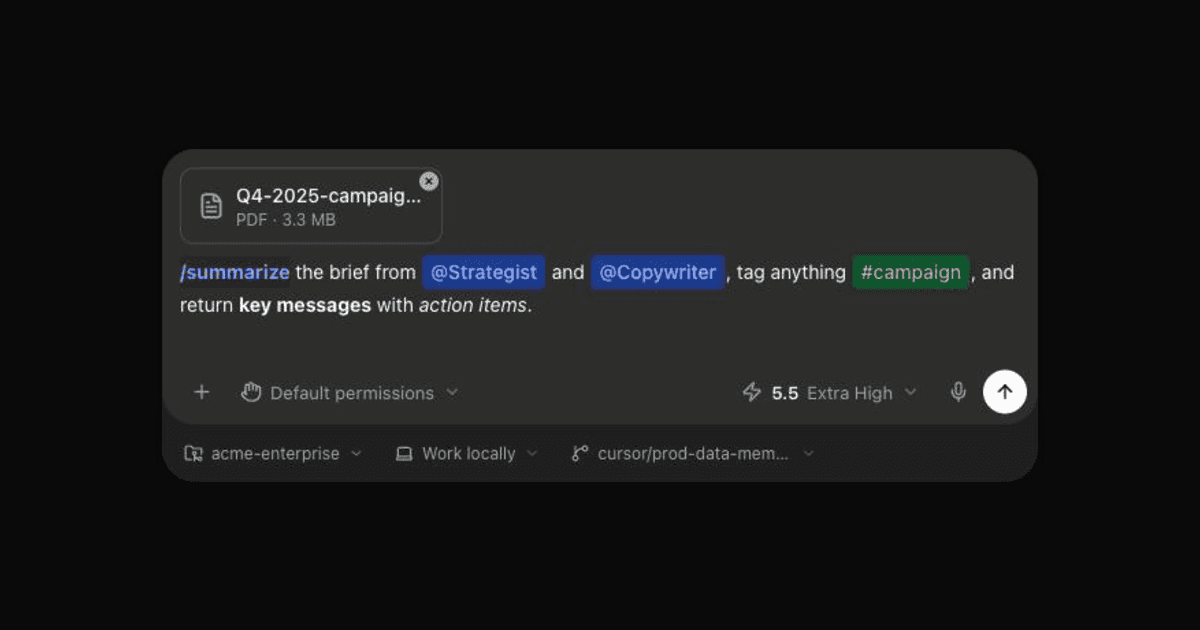
Your homepage should run the product
I rebuilt the Prompt Area homepage around the live component instead of copy about it. For a developer tool, the demo is not a section on the page. It is the page.
· 3 min
3 min read - 06

Build for the model you'll lose
The best coding model in the world lasted three days before a government directive switched it off. The lesson is not 'use local models.' It is 'never couple your product to a model you are not allowed to keep.'
· 3 min
3 min read - 05

Agent memory is mostly hoarding
Stuffing every past message into context is not memory, it is hoarding. Real memory is knowing what to forget.
· 2 min
2 min read - 04

Context is the new CMS
For twenty years teams ran a content management system. The next era runs on context management: what your AI knows before it writes a word.
· 2 min
2 min read - 03

Your evals are the moat
Your prompts are not your moat. Your model is not your moat. The test suite that catches silent regressions is the thing nobody can copy.
· 2 min
2 min read - 02

A bigger model won't save you
Most 'we need a bigger model' complaints are context engineering problems in disguise. A smaller model with the right context beats a frontier model fed a junk drawer.
· 2 min
2 min read